Wolf Range Repair: Why a Small Convection Fan Switch Problem Can Stop Your Oven — Fixed in One Visit
Wolf range repair isn’t always about replacing expensive electronic components. Modern Wolf ranges are built for exceptional performance and decades of reliable cooking, but even premium appliances can develop small mechanical problems over time. This week’s repair showed how a simple issue behind the control panel prevented the convection fan from operating correctly—and how an accurate diagnosis allowed us to complete the repair during a single visit.
This week, our technicians completed a Wolf range repair that perfectly demonstrates why an accurate diagnosis is far more important than replacing parts. The homeowner noticed that the oven’s convection fan wasn’t responding consistently. Sometimes it worked normally, while other times the control knob felt different, and the fan wouldn’t start at all. At first glance, many people would assume the convection fan motor, electronic control board, or switch itself had failed.
Fortunately, that wasn’t the case.
After carefully inspecting the control panel, we discovered that the actual problem was much simpler—a cracked mounting nut securing the convection fan switch had allowed the switch to move out of position. Once the mounting hardware was repaired and the switch was properly secured, the convection fan operated exactly as it should. Better yet, we completed the repair during the same visit without ordering expensive electronic components.
Repairs like this are exactly why we always tell homeowners that diagnosis comes before replacement. What appears to be a major electrical failure is sometimes nothing more than a small mechanical problem hiding behind the control panel.
What Does the Convection Fan Do on a Wolf Range?
The convection fan is one of the most important components inside a modern Wolf oven. Unlike conventional baking, which relies mainly on radiant heat, convection cooking continuously circulates hot air throughout the oven cavity. This moving air creates a more consistent cooking environment and helps eliminate hot and cold spots.
A properly operating convection system offers several advantages:
- Faster preheating
- More even baking
- Better roasting performance
- Improved browning
- Consistent temperatures on multiple oven racks
- Reduced cooking time for many recipes
Whether you’re baking cookies, roasting vegetables, or preparing a holiday turkey, the convection fan helps distribute heat evenly throughout the oven.
When the fan doesn’t operate correctly, homeowners may notice:
- Uneven cooking
- Food browning on one side only
- Longer cooking times
- Inconsistent oven temperatures
- Reduced baking performance
Fortunately, these symptoms don’t always mean the fan motor has failed.
Understanding the Convection Fan Switch
Every time you turn the convection fan knob, you’re actually operating a small mechanical switch hidden behind the front control panel.
Although it’s relatively small, this switch performs an important job. When the knob rotates, the switch opens or closes an electrical circuit that allows the convection fan motor to operate.
The switch itself is mounted behind the control panel using a threaded body and a retaining nut. That nut keeps everything firmly aligned so that the knob, switch, and electrical contacts all move together.
As long as the mounting hardware remains secure, the switch provides years of dependable operation.
However, if the retaining nut loosens, cracks, or breaks, the entire switch can shift slightly inside the panel.
That tiny amount of movement is often enough to create symptoms such as:
- The knob feels loose.
- The switch feels inconsistent.
- The fan only works occasionally.
- The fan starts after several attempts.
- The switch no longer feels solid when turned.
Interestingly, the switch itself may still be perfectly functional.
The Customer’s Concern
The homeowner contacted us after noticing inconsistent operation from the convection fan.
Some days the fan operated normally.
Other times, nothing happened when the knob was turned.
Eventually, the customer also noticed the control didn’t feel quite as solid as before. The knob seemed to have a little extra movement, although it wasn’t obvious enough to immediately point toward a mechanical issue.
Because Wolf ranges use sophisticated electronics, many homeowners understandably worry that a problem like this means an expensive control board replacement.
That’s a reasonable assumption—but it’s not always the correct one.
Our Diagnostic Process
One of the biggest differences between replacing parts and repairing appliances is knowing how to diagnose the problem before ordering anything.
At PowerOn Appliance Repair Service, we begin every repair by verifying the customer’s complaint and inspecting the appliance systematically. Instead of assuming which component failed, we work through the appliance one step at a time until we identify the actual cause.
For this Wolf range, our technician first confirmed the customer’s description of the problem.
The convection fan responded inconsistently.
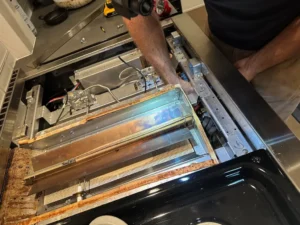
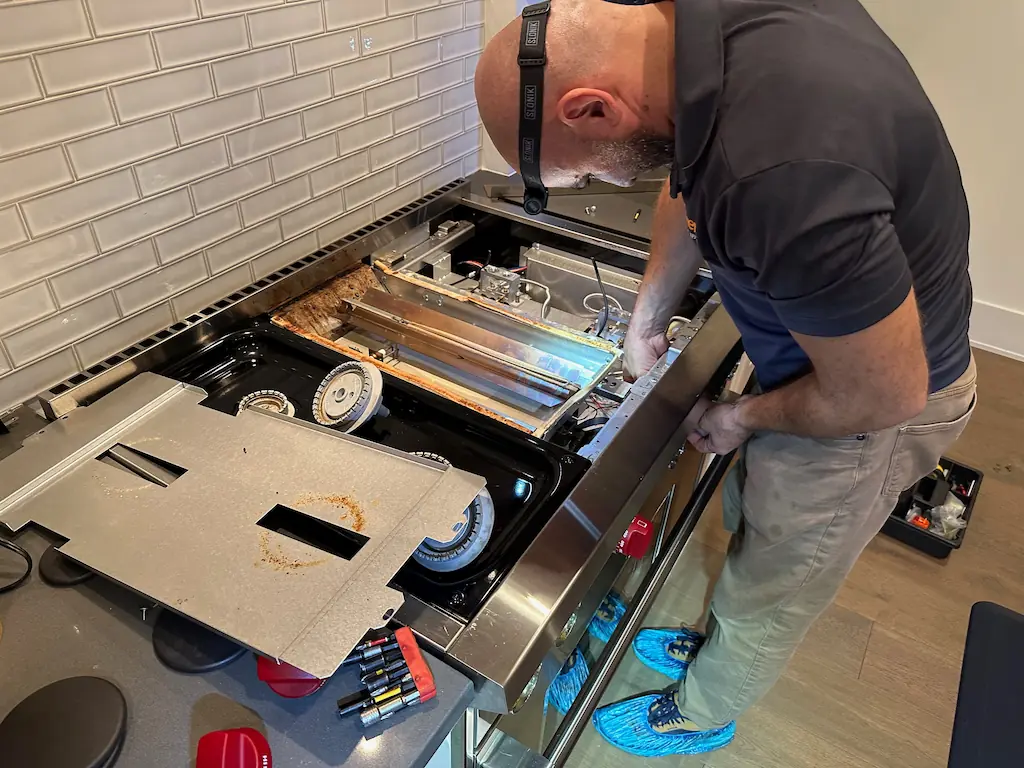
Next, we removed the control panel for a closer inspection.
Almost immediately, the cause became obvious.
Rather than finding burned wiring, failed electronics, or a defective switch, we found that the retaining nut securing the convection fan switch had cracked. Because the nut was no longer holding the switch firmly in place, the switch shifted every time the customer turned the control knob.
That small amount of movement prevented the switch from making reliable electrical contact.
The switch itself was still working.
The control board was working.
The fan motor was working.
The problem wasn’t electronic at all—it was mechanical.
Why Proper Diagnosis Saves Money
Situations like this happen far more often than many homeowners realize.
When symptoms appear electrical, it’s easy to assume an expensive electronic component has failed.
Unfortunately, replacing parts without confirming the cause can become very expensive.
For example, a technician unfamiliar with Wolf appliances might replace:
- the convection fan switch,
- then the fan motor,
- or even the electronic control board,
only to discover that none of those components were actually defective.
Meanwhile, the original cracked mounting nut remains untouched.
That’s exactly why we believe in one simple philosophy:
Diagnose first. Replace parts only when testing proves they’re actually defective.
This approach saves homeowners money, reduces unnecessary repairs, and often gets premium appliances back in service much faster.
Completing the Repair
Because our service vehicles are stocked with many of the hardware components commonly needed for premium appliance repairs, we were able to complete this repair during the same appointment.
After replacing the damaged mounting hardware and securing the convection fan switch properly behind the control panel, we tested the operation several times.
The control knob now felt firm and precise.
The convection fan responded immediately every time it was activated.
There were no intermittent failures, no loose movement, and no need to replace perfectly good electrical components.
Instead of scheduling another visit or waiting days for special-order parts, the homeowner had a fully functioning Wolf range again before we left.
Repairs like this remind us that sometimes the smallest components can create the biggest symptoms. More importantly, they demonstrate why experience matters. Knowing where to look—and recognizing the difference between a failed part and a simple mounting issue—can mean the difference between a quick, affordable repair and an unnecessary replacement of expensive components.
Common Signs Your Wolf Convection Fan Switch May Be Failing
Most homeowners don’t think about the convection fan switch until something stops working. However, the switch often gives subtle warning signs before it fails completely. Recognizing those early symptoms can help you schedule a repair before the problem becomes more serious.
Common signs include:
- The convection fan doesn’t start every time you turn the knob.
- The control knob feels loose or wobbly.
- The knob turns farther than it used to.
- You need to jiggle the knob before the fan starts.
- The fan turns off unexpectedly during cooking.
- Baking results become inconsistent from one rack to another.
- The oven still heats normally, but convection mode doesn’t work correctly.
These symptoms don’t automatically mean the switch itself has failed. As this week’s repair demonstrated, a loose or damaged mounting nut can produce nearly identical symptoms while the electrical switch remains perfectly functional.
That’s one reason a professional diagnosis is so valuable—it helps identify the real cause before unnecessary parts are replaced.
Why Mechanical Problems Are Often Misdiagnosed
Modern appliances contain sophisticated electronics, but not every malfunction begins with a circuit board or electronic component.
On premium appliances like Wolf ranges, many controls still rely on mechanical hardware working together with electrical switches. When a mounting bracket loosens or a retaining nut cracks, the electrical component may stop operating correctly even though nothing inside the switch has actually failed.
To someone unfamiliar with Wolf appliances, the symptoms can easily resemble a bad control board or defective switch.
That’s why replacing parts based solely on symptoms can become expensive very quickly.
At PowerOn Appliance Repair Service, our technicians verify every diagnosis before recommending replacement parts. We inspect the mechanical components, electrical connections, switches, and controls to determine exactly what’s preventing the appliance from operating correctly.
Sometimes that process confirms an electronic failure.
Other times—like this repair—it reveals a much simpler mechanical issue.
Either way, homeowners receive a repair based on evidence rather than guesswork.
Can You Repair a Wolf Convection Fan Switch Yourself?
Many homeowners enjoy tackling DIY projects around the house, but repairing a Wolf range requires caution.
Although replacing mounting hardware might appear straightforward, accessing the convection fan switch involves removing sections of the front control panel while working around high-voltage electrical components.
Even after disconnecting power, sharp metal edges and delicate wiring remain inside the appliance. In addition, premium Wolf ranges are designed with tightly fitted trim pieces and specialized mounting hardware that can be damaged if removed incorrectly.
A few common mistakes include:
- Damaging stainless steel trim while removing the control panel.
- Pulling electrical connectors loose.
- Cracking decorative control bezels.
- Overtightening replacement hardware.
- Misaligning the switch during reassembly.
If the mounting hardware isn’t installed correctly, the new switch can fail prematurely or continue operating inconsistently.
For most homeowners, having an experienced technician perform the repair is usually the safest and most cost-effective option.
A Word About Cleaning Crews and Premium Appliances
One topic we frequently discuss with homeowners involves professional cleaning services.
Most housekeepers and cleaning crews do an excellent job maintaining beautiful kitchens. However, luxury appliances such as Wolf, Sub-Zero, Thermador, Viking, and Miele are very different from standard residential appliances, and many cleaning professionals simply haven’t received training on their specialized controls.
That isn’t a criticism—it’s simply the reality.
For example, if a control knob begins feeling slightly stiff, someone trying to clean around it may naturally apply more force.
Unfortunately, extra pressure can place stress on the switch mounting hardware hidden behind the control panel.
Likewise, spraying liquid cleaner directly onto the control panel can allow moisture to work behind the knobs, eventually reaching switches and electrical contacts that were never intended to be exposed to liquids.
Abrasive cleaning pads may also scratch stainless steel finishes or gradually loosen decorative trim pieces around the controls.
Fortunately, preventing these problems is easy.
A quick conversation with your cleaning crew can make a significant difference.
We usually recommend three simple guidelines:
- Spray cleaning products onto a microfiber cloth instead of directly onto the appliance.
- Never force a control knob that feels stiff or unusual.
- Report any loose controls immediately so they can be inspected before additional damage occurs.
Those simple habits help protect an investment that may have cost well over $10,000.
For homeowners who want to learn more about caring for their appliance, Wolf also provides an official video demonstrating recommended cleaning techniques for gas ranges. Watching the manufacturer’s guidance is a great way to avoid common cleaning mistakes that can affect both the appearance and long-term performance of your range. See the Wolf Gas Range Interior Cleaning & Care video.
Simple Maintenance Tips That Help Extend the Life of Your Wolf Range
Wolf ranges are engineered to provide decades of reliable service, but like any premium appliance, they benefit from routine care.
Fortunately, maintaining your range doesn’t require complicated procedures.
A few simple habits can dramatically reduce wear on switches, controls, and moving components.
We recommend:
- Wipe the control panel with a soft microfiber cloth after cooking.
- Avoid spraying cleaners directly onto knobs or switches.
- Check that all knobs feel secure and rotate smoothly.
- Keep grease from building up around control shafts.
- Clean spills promptly before they harden.
- Have unusual noises or loose controls inspected before they become larger repairs.
- Schedule professional maintenance if your range receives heavy daily use.
These simple steps won’t eliminate every repair, but they can significantly extend the life of many components while helping your Wolf range continue performing the way it was designed.
Why Experience with Wolf Appliances Matters
Not every company specializing in Wolf range repair regularly services luxury cooking appliances correctly.
Brands like Wolf, Sub-Zero, Cove, Viking, Thermador, Miele, Dacor, JennAir, Monogram, and Fisher & Paykel are engineered differently than standard residential appliances. Their control systems, installation methods, and internal components often require specialized knowledge and experience.
Over the years, we’ve repaired many premium appliances throughout Spring, The Woodlands, Conroe, Magnolia, Montgomery, Tomball, Cypress, Katy, Willis, Huntsville, Shenandoah, and surrounding North Houston communities.
That experience helps us recognize common wear patterns much faster.
Instead of assuming the most expensive component has failed, we focus on finding the actual cause of the problem.
Sometimes the solution involves replacing a major component.
Other times—as this repair demonstrated—the solution is as simple as securing a small piece of mounting hardware that most homeowners never even knew existed.
That’s the difference experience can make.
Frequently Asked Questions About Wolf Range Repair
Why isn’t my Wolf convection fan working?
Several problems can prevent the convection fan from operating properly. A faulty switch, damaged wiring, defective fan motor, failed control board, or even a loose mounting nut can all produce similar symptoms. Because these issues often look alike, professional diagnosis is the best way to determine the actual cause before replacing expensive parts.
Can a loose switch cause the convection fan to stop working?
Yes. During this repair, the electrical switch itself was still functioning correctly. The problem was a cracked mounting nut that allowed the switch to shift behind the control panel, preventing reliable electrical contact. Once the mounting hardware was secured, the convection fan worked normally again.
Is it safe to continue using my Wolf range if the convection fan isn’t working?
The oven may still heat in conventional bake mode, but cooking performance can become inconsistent. Continuing to use the appliance with a loose control or intermittent switch may also allow the problem to worsen over time. Having the range inspected early often prevents additional repairs.
Do you repair all Wolf range models?
Yes. Our technicians diagnose and repair many residential Wolf cooking appliances, including gas ranges, dual-fuel ranges, wall ovens, cooktops, rangetops, and built-in ovens. We also service many other premium appliance brands throughout North Houston.
Which premium appliance brands do you repair?
In addition to Wolf appliances, we regularly service Sub-Zero, Cove, Viking, Thermador, Miele, Dacor, JennAir, Monogram, Fisher & Paykel, Bosch, KitchenAid, GE Café, and many other residential appliance brands.
Why Homeowners Throughout North Houston Choose PowerOn Appliance Repair Service
When you own a premium appliance like a Wolf range, choosing the right repair company matters just as much as choosing the right appliance. High-end cooking equipment is engineered differently than standard residential ranges, and successful repairs often depend on experience rather than guesswork.
At PowerOn Appliance Repair Service, we believe every repair should begin with a thorough diagnosis—not an assumption. Our technicians take the time to inspect the appliance, verify the failure, and explain exactly what we find before recommending any repair. That approach helps homeowners avoid unnecessary parts, reduces repeat visits, and often saves both time and money.
Whether the problem involves a convection fan switch, an igniter, a temperature sensor, a control board, or another component, our goal is always the same: restore your appliance safely and efficiently while recommending only the repairs that are actually needed.
We proudly provide Wolf range repair and premium appliance service throughout Spring, The Woodlands, Conroe, Magnolia, Montgomery, Tomball, Cypress, Katy, Willis, Huntsville, Shenandoah, Houston, Kingwood, Porter, and surrounding North Houston communities.
If you need professional Wolf range repair, don’t assume the most expensive component has failed. Sometimes, as this repair demonstrated, the solution is much simpler than expected.
Final Thoughts
This Wolf range repair is a perfect example of why proper diagnosis matters.
The homeowner experienced inconsistent convection fan operation and understandably expected a complicated electrical repair. Instead, the actual problem was a small piece of mounting hardware hidden behind the control panel.
Once the damaged mounting nut was replaced and the switch was secured correctly, the convection fan returned to normal operation—without replacing a perfectly good switch, fan motor, or electronic control board.
It’s a reminder that premium appliances deserve careful troubleshooting by technicians who understand how they’re designed.
If your Wolf range has a loose control knob, intermittent convection fan, or any other performance issue, we’re here to help. We’ll diagnose the problem first, explain what we find, and recommend only the repair that’s truly necessary.
At PowerOn Appliance Repair Service, we don’t work for today—we work for tomorrow.