Whirlpool Washer Wire Harness Repair: Why Your Washer Still Won’t Work After Replacing Parts
A Whirlpool washer wire harness repair may not be the first solution that comes to mind when a washer stops working. However, wiring problems can create the same symptoms as a bad motor, sensor, or control board. That was exactly what happened with a Whirlpool top-load washer we repaired this week. This job shows why accurate diagnosis matters more than replacing parts one by one.
Whirlpool Washer Wire Harness Repair Begins with the Right Diagnosis
By the time we received the call, another technician had already replaced several parts. The previous technician replaced the lid lock, capacitor, shift actuator, control board, and several motor-related components. Even after those repairs, the washer continued showing the same symptoms.
At first, that history may sound like it made the job more difficult. In reality, it gave us useful information. We knew several major components had failed to solve the problem.
We ran the washer in diagnostic test mode. Almost immediately, we found a communication problem between the motor system and the control board. When those components cannot communicate, technicians should inspect the wire harness before replacing expensive components.
Why Whirlpool Washer Wiring Problems Get Misdiagnosed
A washer that stops during a cycle can have several possible causes. It may display an error code, fail to spin, or stop responding completely. Because the control board acts as the machine’s brain, technicians often suspect it first.
However, replacing the control board cannot fix a broken connection. If damaged wiring interrupts the signal, the replacement board often produces the same symptoms as the original one. As a result, the customer pays for an expensive part while the washer remains broken.
The wire harness contains individual wires and connectors that link the control board, motor, sensors, and other components. Years of vibration, heat, moisture, and normal use can weaken these connections. A connector may loosen, a wire may break internally, or corrosion may develop around a terminal.
In many cases, a quick visual inspection often misses hidden wiring damage. Therefore, technicians must test the wiring, connectors, and continuity instead of relying only on appearance.
How We Diagnosed the Whirlpool Washer
Instead of replacing another part, we used the washer’s built-in diagnostic test mode. This mode allows a technician to activate and evaluate individual components. It can help test the motor, drain pump, lid lock, control board, and other operating systems.
During the diagnostic test, the motor failed to respond correctly. Since the control board had already been replaced, we focused on the connection between the board and the motor. Next, we inspected the wire harness connecting the motor and control board.
Whirlpool also provides official repair and troubleshooting resources for appliance owners. However, a qualified appliance technician should perform electrical testing and internal repairs.
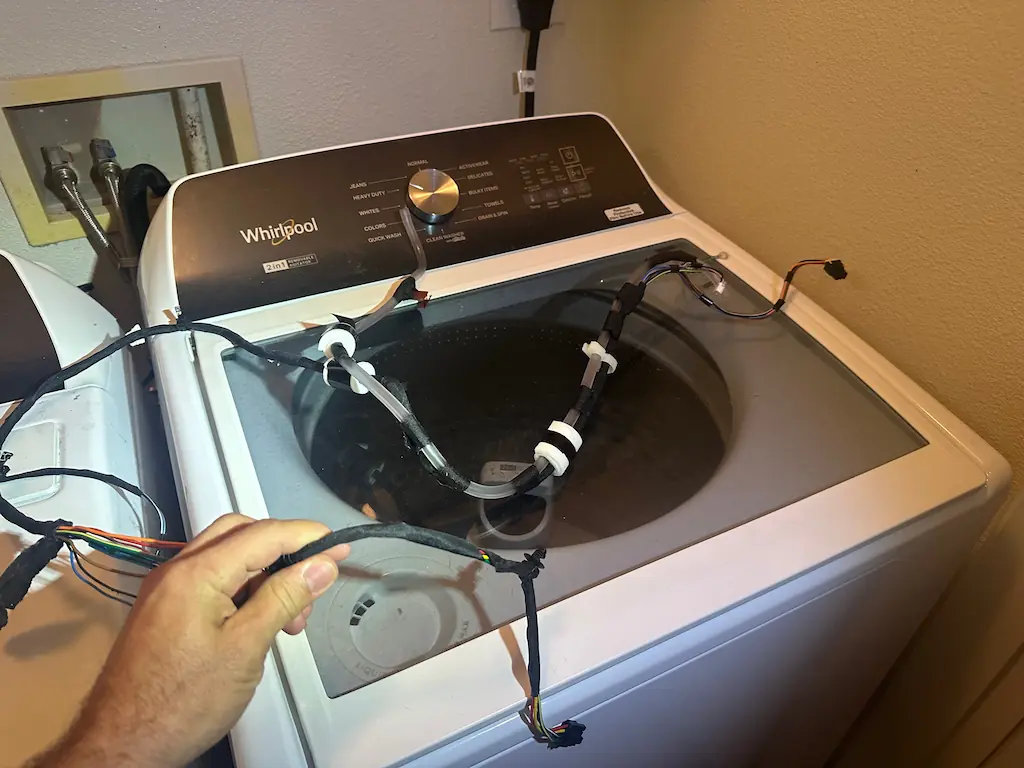
The Whirlpool Washer Wire Harness Repair
We replaced the wire harness connecting the motor system and control board. Next, we carefully reconnected each terminal and checked the connections.
After completing the Whirlpool washer wire harness repair, we ran another diagnostic test. The new wire harness immediately restored communication between the motor and control board. We then ran a complete wash cycle to confirm that the washer could fill, agitate, drain, and spin normally.
The washer completed every test cycle without errors or interruptions. We didn’t need another control board, shift actuator, or capacitor.
Signs You May Need a Whirlpool Washer Wire Harness Repair
A damaged wire harness can create several symptoms. These may include:
- The washer stops before completing the cycle.
- The washer fills but does not agitate or spin.
- Error codes return after parts have been replaced.
- The motor responds during some tests but not others.
- The washer behaves differently from one cycle to the next.
- Replacing the control board does not solve the original problem.
These symptoms do not always indicate a wiring failure. Still, they show why the wire harness and connectors should be tested before replacing more expensive components.
What This Means for Washer Owners
If your washer still has the same problem after a repair, it does not always need another new part. The first diagnosis may have overlooked a wiring or communication issue.
Before replacing a control board, motor, or another expensive component, ask whether the wiring and connectors were tested. A proper electrical diagnosis can prevent unnecessary repairs and save money.
We see similar problems on Whirlpool, Maytag, and other top-load washers. For that reason, we check communication wiring whenever a customer tells us that several parts were replaced but the washer still has the same symptoms.
If you own a Whirlpool appliance, visit our Whirlpool appliance repair page to learn more about the models we service.
Why Accurate Diagnosis Saves Money
These symptoms do not always indicate a wiring failure. In this case, multiple components had already been replaced before we arrived. After running Whirlpool’s diagnostic mode and testing the electrical circuit, we identified the actual failure in the wire harness. Fixing the correct problem restored the washer without replacing another expensive electronic component.
Serving Spring and the Surrounding Area
PowerOn Appliance Repair Service provides professional washer repair throughout Spring, The Woodlands, Tomball, Cypress, Katy, Conroe, Magnolia, Montgomery, Willis, Huntsville, and Shenandoah.
If your Whirlpool washer has already been repaired but still does not work correctly, call us before replacing another part. We will test the machine properly and identify the actual cause before recommending a repair.
PowerOn Appliance Repair Service — Spring, TX | (346) 379-3809 | poweronappliance.com