
Quick answer: If one side of your Sub-Zero stops cooling and the control board keeps clicking off and back on every few seconds, the main control board (often called the relay board) is usually failing. The board resets before it can hold the compressor on, so the freezer slowly warms up. The fix is a Sub-Zero control board replacement, set up and programmed for your exact model. The most common reasons these boards fail are power surges, nearby lightning strikes, unstable generator power, low voltage, heat and age.
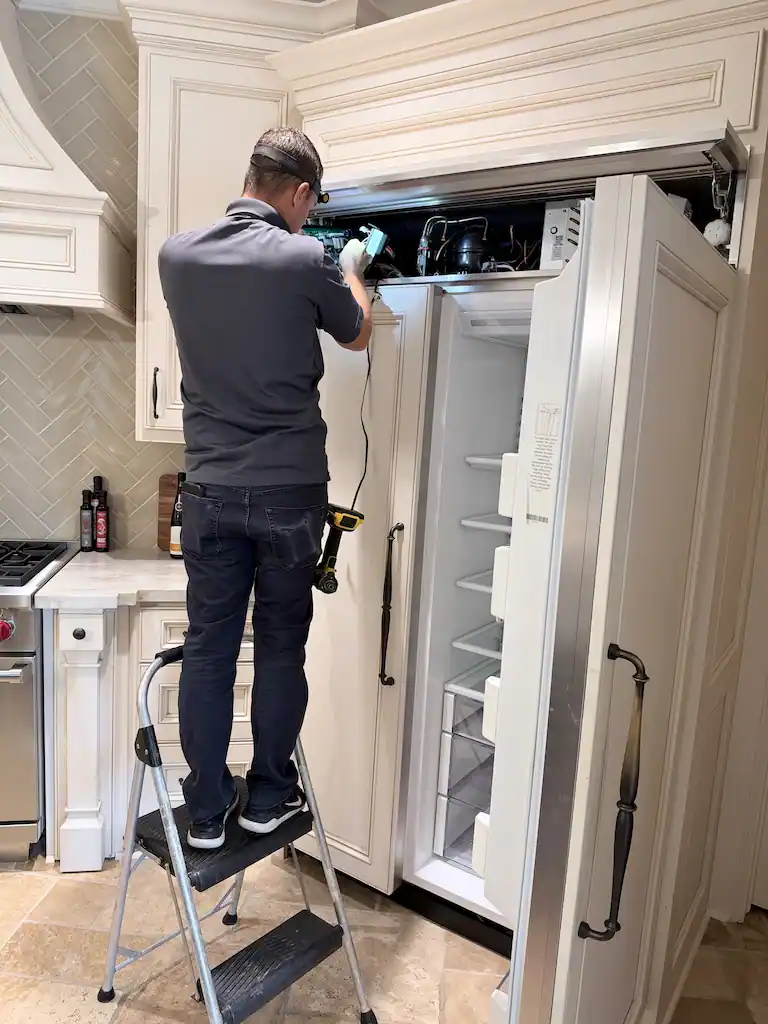
Recently we got a call from a homeowner in The Woodlands. Their built-in Sub-Zero side-by-side looked fine from the outside, but the freezer side was slowly losing its cold. Ice cream was soft. The fresh food side was holding on, but barely.
For a refrigerator that cost as much as a used car, that is a stressful morning. Here is what we found, how we fixed it, and what you can do so it does not happen to your refrigerator.
What We Found: A Control Board That Would Not Stay On
On a built-in Sub-Zero, the “brain” and the compressor live up top, behind the grille above the doors. Our technician opened the grille and started at the beginning: power to the unit, temperatures, then the electronics.
The main control board was flickering. Every three to five seconds it shut off completely and then powered back up. Over and over.
Think of it like a computer that keeps rebooting before it finishes loading. The board is the part that tells the compressor and fans when to run. If it never stays awake long enough to give a steady command, the compressor never gets a real chance to run. No compressor, no cooling. The freezer side feels it first because it needs the most work to stay at temperature.
Before we called it a bad board, we checked the things that can make a good board act like a bad one: the voltage coming from the outlet, the wiring and connectors, and whether anything the board powers (like a fan motor) was shorted and dragging it down. Everything else checked out. The board itself was the problem.
The Repair: New Board, Correct Programming, Compressor On
Sub-Zero control boards are not a common part you find on a supply house shelf, so we ordered the correct board for this model and came back to install it as soon as it arrived.
Installing the board is only half the job. A new Sub-Zero control board has to be set up for the exact model it is going into. The board needs to know what refrigerator it is running, or it will not control the system correctly. We went through the programming steps, confirmed the settings, and powered the unit back up.
Then came our favorite part of the job: the sound of the compressor kicking on. Every technician knows that sound. It means the system is alive again and the repair worked. We stayed to confirm the fans were running, the compressor held steady, and both sides were pulling down toward temperature.
A $10,000+ refrigerator saved with one part and the right setup. That is a much better outcome than replacing a built-in that is framed into custom cabinetry.
Why Refrigerator Control Boards Fail
Control boards don’t usually just “wear out” for no reason. Most of the time, something outside the board damaged it, slowly or all at once. These are the causes we see most often in Spring, The Woodlands, Conroe, Tomball and the rest of the North Houston area.
1. Power surges
A power surge is a short spike in voltage, often lasting less than a second. Your refrigerator is built for about 115 to 120 volts. A surge can push hundreds or even thousands of volts through the line for a split second.
Big surges can kill a board instantly. Small surges are sneakier. They happen many times a year and slowly weaken the tiny parts on the board until one day it fails. Common sources include the utility switching power on the grid, large equipment in your own home (AC compressors, pool pumps, well pumps) turning on and off, and the moment power comes back after an outage.
2. Lightning
Lightning does not have to hit your house to damage your appliances. A strike on a nearby power line, transformer, or even the ground close to your home can send a surge through your electrical system. Southeast Texas gets a lot of thunderstorms, especially in spring and summer and during hurricane season. After a big storm, we often see a cluster of failed boards on refrigerators, ovens, washers and dishwashers.
3. Generator power
After the long outages Houston has seen in recent years, many families now run generators. That is a smart move, but generator power is not always the same as power from the utility.
- Portable (conventional) generators can produce “dirty” power. The voltage and frequency can rise and drop as the engine speeds up and slows down under load. The power wave can also be distorted. Refrigerator electronics do not like this, and repeated exposure can damage the board.
- Inverter generators produce much cleaner, steadier power and are a safer choice for running sensitive appliances.
- Whole-home standby generators are usually fine when they are properly sized and installed with an automatic transfer switch. The risky moments are the switch-over itself and an undersized unit struggling when several big loads start at once.
- Never backfeed a generator into your home through a dryer outlet or any other outlet. Besides the risk to your appliances, it can send power back onto the utility lines and seriously injure line workers. Use a transfer switch installed by a licensed electrician.
4. Low voltage and flickering power (brownouts)
Low voltage is as hard on electronics as high voltage. When voltage drops, motors and compressors pull more current to keep working, and relays on the board can chatter or burn their contacts. Power that flickers on and off several times during a storm is especially rough, because each restart puts stress on the compressor and the board.
5. Heat
On built-in Sub-Zero units, the board sits up in the same compartment as the compressor and condenser. If the condenser is clogged with dust and lint, that area runs hotter. Heat dries out the small capacitors on the board and shortens its life. Cleaning the condenser regularly protects the compressor and the electronics.
6. Moisture, dust and pests
Houston humidity, kitchen grease and dust can build up on a board over the years. In some homes, insects or rodents get into the top compartment. Any of these can create small short circuits or corrosion on the connectors.
7. Another part failing first
Sometimes the board is the victim, not the cause. A shorted fan motor, a failing compressor start component, or a damaged wire can pull too much current through the board and burn a relay or trace. If that root cause is not found, a brand-new board can fail the same way. This is why we test everything the board controls before installing a replacement.
8. Age
Electronics age. Many Sub-Zero refrigerators run for 15 to 20 years or more, and over that time the components on a control board slowly break down. An older board is also less able to survive a surge that a newer one might shrug off.
How to Protect Your Refrigerator’s Control Board
- Install a whole-home surge protector. A licensed electrician can add one at your electrical panel. It protects every appliance in the house, including the ones that are hardwired.
- Use a dedicated, grounded outlet. Sub-Zero refrigerators should be on their own properly grounded circuit. Avoid extension cords and ordinary power strips.
- Be smart during storms and outages. If the power is flickering, you can turn the refrigerator off at the control panel or breaker until power is stable. After an outage, give the power a few minutes to settle before turning large appliances back on.
- Run sensitive appliances on clean generator power. Choose an inverter generator or a properly installed standby generator with a transfer switch.
- Keep the condenser clean. A clean condenser keeps the top compartment cooler, which helps both the compressor and the board.
- Don’t ignore early warning signs. Clicking sounds, a display that resets, lights that blink, or one side running warmer than usual are worth a service call before the food spoils.
Signs Your Refrigerator Control Board May Be Failing
- One side (often the freezer) is warming up while the other side seems okay
- Repeated clicking from the top of the unit every few seconds
- The display, interior lights or fans turning off and back on by themselves
- Compressor that never starts, or starts and stops right away
- Error codes or a control panel that won’t respond
- A burnt smell or visible scorch marks on the board
Any of these can also come from other problems, like a bad fan, a failed sensor, or a sealed system issue. That is why a proper diagnosis comes first.
For Technicians: How We Approach a Suspected Board Failure
If you are a tech reading this, here is the process that keeps us from throwing parts at a problem:
- Verify incoming power under load. Check voltage at the outlet with the unit running, and confirm a solid neutral and ground. A loose neutral or a weak circuit can make a healthy board reset.
- Watch the symptom. A board that powers down and back up on a short, regular cycle points toward the board’s own power supply section, but confirm it.
- Check every load the board drives. Measure fan motors, the compressor circuit, heaters and valves for shorts or high current draw before you install a new board. A shorted load will kill a new board just like the old one.
- Inspect connectors and harnesses. Look for heat discoloration, corrosion, or loose pins. Burnt connectors should be repaired or replaced at the same time.
- Handle the new board carefully. Use static protection, keep it in its bag until install, and don’t touch components or traces.
- Program the board to the model. Follow the manufacturer’s tech sheet for the exact model and serial. Skipping or rushing this step leads to callbacks.
- Confirm the system before you leave. Compressor start, condenser and evaporator fans running, temperatures pulling down, and no error codes. Explain to the customer how surges and power quality affect the new board.
Why Woodlands Homeowners Call PowerOn for Sub-Zero Repair
PowerOn Appliance Repair Service is a family-run company that has been fixing appliances in Spring, The Woodlands and the North Houston area since 2018. We are BBB Accredited and rated 4.9 stars across more than 1,500 customer reviews. High-end brands like Sub-Zero, Wolf, Thermador and Viking are a big part of our daily work, and we treat them like the investment they are.
We diagnose carefully on the first visit, explain the fix in plain language, and give you the price before any work begins. Repairs are backed by up to one year of warranty on parts and labor. We work for tomorrow, not for today, which means we fix the cause, not just the symptom.
We serve Spring, The Woodlands, Conroe, Tomball, Cypress, Katy, Magnolia, Montgomery, Willis, Shenandoah, Huntsville and nearby communities. If your Sub-Zero is acting up, schedule a Sub-Zero repair with PowerOn or call (346) 379-3809. For use-and-care guides on your model, see Sub-Zero’s official site.
Frequently Asked Questions
Why is my Sub-Zero freezer not cooling but the refrigerator side is fine?
The freezer side usually shows problems first because it needs the most cooling. Common causes include a failing main control board, a bad evaporator or condenser fan, a dirty condenser, a defrost problem, or a sealed system issue. A technician should test the board, fans and compressor to find the real cause.
What does it mean when a refrigerator control board keeps turning on and off?
A board that powers down and restarts every few seconds is usually failing in its own power supply section. It can’t stay on long enough to run the compressor, so the refrigerator stops cooling. Low incoming voltage or a shorted part can cause similar behavior, so those should be ruled out first.
Can a power surge damage my refrigerator?
Yes. A power surge can damage the electronic control board instantly, or weaken it over time with many small surges. Surges come from utility switching, power returning after an outage, lightning, and large equipment cycling in your home.
Can lightning damage appliances if it doesn’t hit my house?
Yes. A lightning strike on a nearby power line, transformer or the ground near your home can send a surge through your wiring and damage refrigerator, oven, washer and dishwasher control boards.
Is it safe to run a Sub-Zero refrigerator on a generator?
It can be, if the power is clean and steady. Inverter generators and properly installed standby generators with a transfer switch are the safest choices. Conventional portable generators can produce unstable voltage and frequency that can damage control boards over time.
Does a new Sub-Zero control board need to be programmed?
Yes. A replacement board has to be set up for the specific model it is installed in. Without correct setup, the refrigerator may not cool or may show errors.
Is it worth repairing a Sub-Zero instead of replacing it?
In most cases, yes. Built-in Sub-Zero units cost thousands of dollars and are fitted into custom cabinetry. A control board replacement costs a small fraction of a new unit and can give the refrigerator many more years of service.
How can I protect my refrigerator’s control board?
Install a whole-home surge protector, use a dedicated grounded outlet, avoid extension cords, run appliances only on clean generator power, keep the condenser clean, and call for service at the first sign of clicking, resetting or uneven cooling.
Who repairs Sub-Zero refrigerators in The Woodlands, TX?
PowerOn Appliance Repair Service repairs Sub-Zero refrigerators in The Woodlands, Spring, Conroe, Tomball and the greater North Houston area. Call (346) 379-3809 or visit poweronappliance.com to schedule.