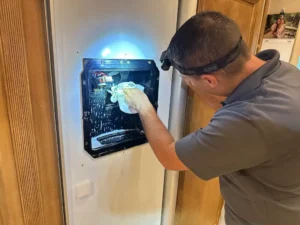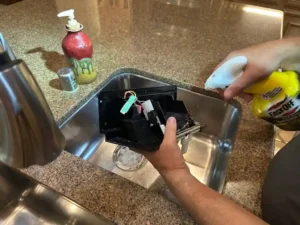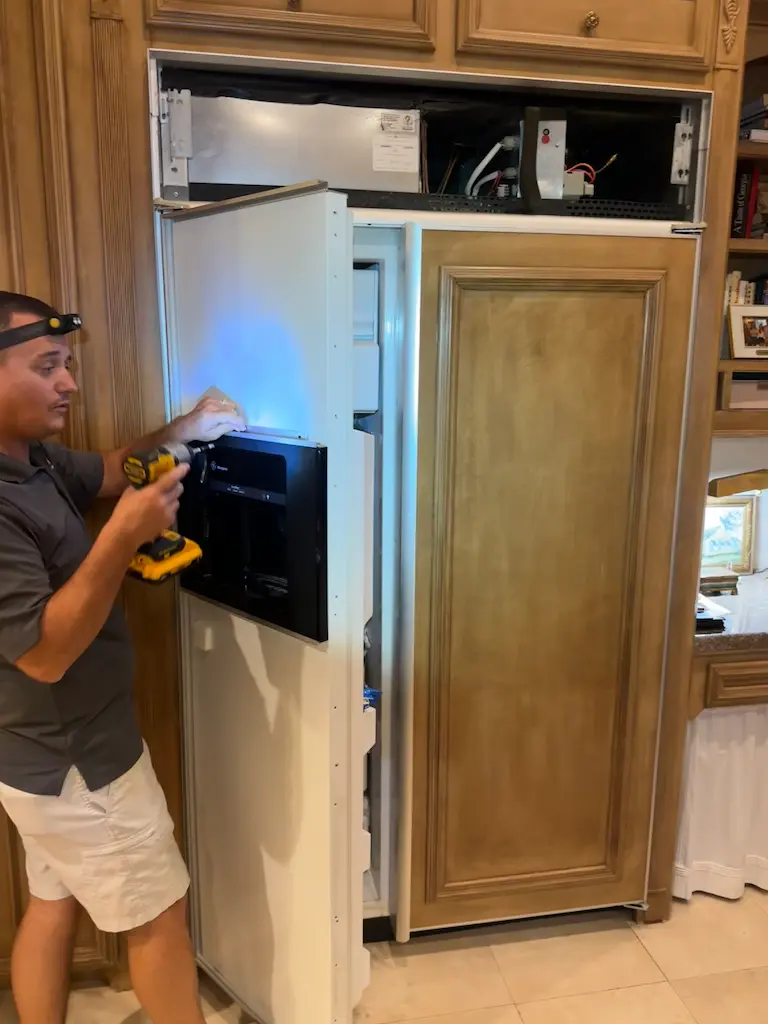
A customer with an older built-in GE refrigerator in The Woodlands called us about a problem a lot of homeowners run into: the ice bucket and dispenser compartment inside the door were filling up with frost and snow instead of staying dry with clean ice.
What we found
The cause was the ice door — the small door inside the dispenser compartment that’s supposed to seal shut between uses. On this unit, it wasn’t closing properly. Every time warm, humid kitchen air got into that compartment, it hit the cold air inside and turned into frost. Left alone, that buildup turns into a block of snow and ice around the bucket, and eventually it can jam the auger or damage the bucket itself.
We replaced the ice door and the retention spring that holds it shut. On some units, the door solenoid — the part that actually pulls the door open and shut — goes bad at the same time. We checked it here and it tested fine, so we left it alone. No sense replacing a part that isn’t the problem.
While we were in there, we also deep cleaned behind the dispenser assembly. This is a step a lot of repairs skip, because it’s not visible from the front and it’s not what the customer called about. But moisture and condensation collect back there constantly, and over time that turns into mold and debris nobody sees until it’s a bigger issue. We check it on every dispenser job regardless of what brought us out — it’s part of doing the job right instead of just doing the job fast.
Ice and water dispensers: advantages and disadvantages
Door dispensers are one of the most-used features on a refrigerator, and also one of the more common sources of service calls. Worth understanding both sides before you decide how much you rely on one.
Advantages:
- Convenience — filtered water and ice without opening the door, which also helps keep cold air inside the fridge.
- Fewer trips to a separate ice maker or a bag of ice from the store.
- Most units filter the water automatically, which some homeowners like for taste and for reducing scale buildup in glasses and pitchers.
Disadvantages:
- More moving parts means more that can fail — door seals, solenoids, auger motors, and switches all live in a small, cold, humid space.
- The ice door seal is a wear part. It doesn’t last the life of the fridge, especially on units that get heavy daily use.
- Condensation behind the dispenser is constant, and if it’s never cleaned, it becomes a hidden mold and debris problem.
- Repairs on built-in and premium units often require brand-specific parts, which can mean a longer wait if a shop doesn’t stock them.
None of this means skip the dispenser — it means treat it like any other mechanical part of the fridge and get it looked at when something’s off, rather than waiting for it to get worse.
Frequently Asked Questions
Why is my ice bucket filling with frost instead of ice?
Almost always a sealing problem. If the ice door inside the dispenser isn’t closing all the way, humid air keeps entering the compartment and freezing on contact, which builds up as frost and eventually snow-like ice around the bucket.
Is this a refrigerant or compressor issue?
No. A frosty ice bucket is a dispenser-door sealing issue, not a cooling-system issue. If your fridge is otherwise cooling normally, the compressor and refrigerant system aren’t the problem.
Can I fix this myself?
The door and retention spring are replaceable parts, but on built-in units the dispenser assembly is tucked in tight and the parts are model-specific. Ordering the wrong part or reinstalling it without a full seal is the most common reason this problem comes right back. On top of that, most built-in refrigerators need the door panel removed to even access the dispenser — doesn’t matter if it’s a wood panel or stainless steel, either way it has to come off first, which adds a layer most homeowners aren’t set up for.
How long does this repair take?
Once the correct parts are on hand, this is typically a one-visit repair. If parts need to be ordered for your specific model, it may take two visits — one to diagnose and order, one to install.
Do you clean behind the dispenser during every repair?
Yes. Moisture collects there regardless of what brought us out for the visit, and it’s not something you can see or clean yourself without pulling the assembly. We check it on every dispenser job.
Do you work on older GE built-in models, or just current ones?
We work on both. Older built-in units like this one are common in North Houston homes and often just need the right parts sourced — the repair itself isn’t more difficult than a newer model.
Have a fridge doing something similar? See our refrigerator repair services in The Woodlands, TX for more on what we cover, or read more on how refrigerator condensation and mold form from the EPA.
PowerOn Appliance Repair Service — Spring, TX and the greater Houston/Woodlands area. We don’t work for today, we work for tomorrow.