
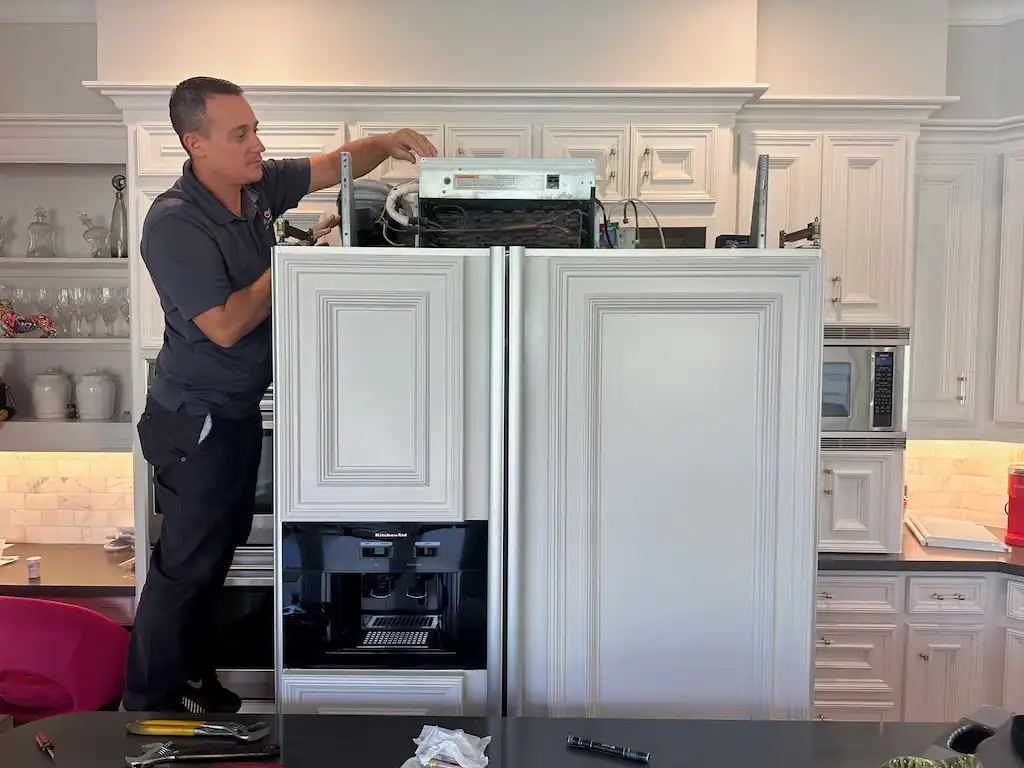
We recently saved a built-in KitchenAid refrigerator in The Woodlands that most repair shops would have written off. The unit had stopped cooling properly, and the diagnosis pointed to a restriction inside the sealed system — the closed network of tubing that carries refrigerant through the compressor, evaporator, and heat exchanger. Once we confirmed it, based on the age, condition, and diagnosis of this particular refrigerator, we determined that a full sealed system rebuild on this built-in refrigerator in The Woodlands, TX was the most reliable repair.
What “sealed system restriction” actually means
The sealed system is a fridge’s circulatory system. Refrigerant flows through it in a continuous loop, changing from liquid to gas and back again to move heat out of the box. On older units, wear, age, and moisture that’s crept in over the years can create a restriction — usually at the drier filter or the capillary tube — that partially or fully blocks that flow. When refrigerant can’t circulate properly, the compressor works harder, cooling drops off, and eventually the unit stops keeping temperature altogether.
The tricky part is that a restriction is rarely an isolated problem. If moisture or debris has made it far enough into the system to cause a blockage, it’s usually already circulated through the rest of the loop. Swapping the one visibly bad part and reconnecting it to a system that’s still contaminated is a short-term fix — the same problem tends to come back within months.
Why we rebuilt instead of patching
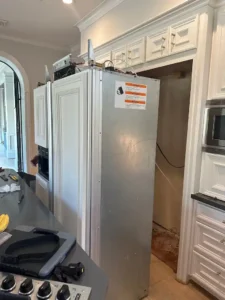
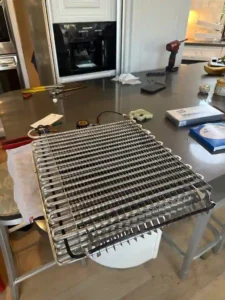
For this KitchenAid, that meant replacing the compressor, evaporator, heat exchanger, and drier filter — effectively giving the unit a clean, moisture-free sealed system from the ground up rather than gambling on one new part restoring an already-compromised loop. It’s a bigger, more labor-intensive job than a standard part swap, but it’s the difference between a repair that lasts and a repair that buys a few more months.
Full rebuild vs. single-part replacement
| Single-part replacement | Full sealed system rebuild | |
|---|---|---|
| Best for | Isolated failures (one component clearly bad, rest of system clean) | Restrictions, contamination, or failures where moisture/debris has spread through the system |
| Cost | Lower upfront | Higher upfront, but addresses the root cause |
| Risk of recurrence | Higher if the underlying contamination wasn’t isolated | Low — system is effectively renewed |
| Typical unit age | Newer units, recent failures | Older units where wear has compounded over years |
Choosing the right one comes down to an accurate diagnosis, not just replacing whatever part looks obviously bad.
Which built-in refrigerators and freezers we work on
We specialize in premium, built-in appliance brands, including:
- Sub-Zero
- Thermador
- KitchenAid
- Jenn-Air
- Viking
- GE Monogram
These are the brands where a full sealed system rebuild consistently makes financial sense.
Why this math works for built-ins but not standalone fridges
This is the part that surprises a lot of homeowners: the same repair that’s a smart investment on a built-in unit can be a bad idea on a standalone refrigerator, and here’s why.
Built-in refrigerators from brands like Sub-Zero, Thermador, KitchenAid, Jenn-Air, and Viking are designed to be integrated into custom cabinetry, cost significantly more than standalone units new, and are built with panel-ready fronts and layouts matched to the kitchen around them. Replacing one outright often means custom cabinetry work, matching panels, and a new unit that can run well into five figures. Against that backdrop, a sealed system rebuild — even a labor-intensive one — is almost always the more economical choice, and it keeps a unit that was built to last decades actually lasting decades.
Standalone refrigerators are a different equation entirely. They’re mass-produced, widely available, and priced to be replaced rather than rebuilt. On a standalone unit, sealed system labor plus parts can climb close to the cost of a comparable new fridge — and on older or lower-end models, it can end up costing more than replacement. When that math doesn’t work in the customer’s favor, we say so. Part of doing this right is telling a customer when repair isn’t the better option, not just when it is.
Frequently Asked Questions
How do I know if my refrigerator has a sealed system restriction?
Common signs include the unit running constantly without reaching temperature, warm spots inside the fridge or freezer compartment, unusual noises from the compressor, or the compressor cycling on and off rapidly. A technician can confirm it by checking pressures and refrigerant flow.
Is a sealed system rebuild the same as a compressor replacement?
Not exactly. A compressor replacement swaps just that one part. A full sealed system rebuild replaces the compressor along with the evaporator, heat exchanger, and drier filter, so the entire refrigerant loop is clean rather than just the one component that failed.
Why not just replace the compressor and see if that fixes it?
If the restriction or contamination has already spread through the system, a new compressor connected to a still-contaminated loop is likely to fail again, sometimes quickly. That’s wasted labor and cost on a fix that doesn’t hold.
Is a sealed system rebuild worth it on my refrigerator?
It depends on the brand and type of unit. On premium built-ins, almost always yes, since replacement costs are so much higher. On standalone refrigerators, we run the numbers with you first, because sometimes a new unit is the better financial call.
Do you work on older built-in models, or just current ones?
Both. Built-in units from these brands are common throughout North Houston homes, and age alone doesn’t rule out a repair — it just changes what the repair needs to include.
How long does a full sealed system rebuild take?
It’s a more involved repair than a standard part swap, typically requiring careful evacuation, replacement of multiple components, and a full recharge and leak-check before the job is complete. Most rebuilds are completed in a single, longer visit.
Curious whether your built-in is a repair or replace situation? See our refrigerator repair services in The Woodlands, TX for more on what we cover, or read more about how refrigerators work and how to keep them efficient from ENERGY STAR.
PowerOn Appliance Repair Service — Spring, TX and the greater Houston/Woodlands area. We don’t work for today, we work for tomorrow.