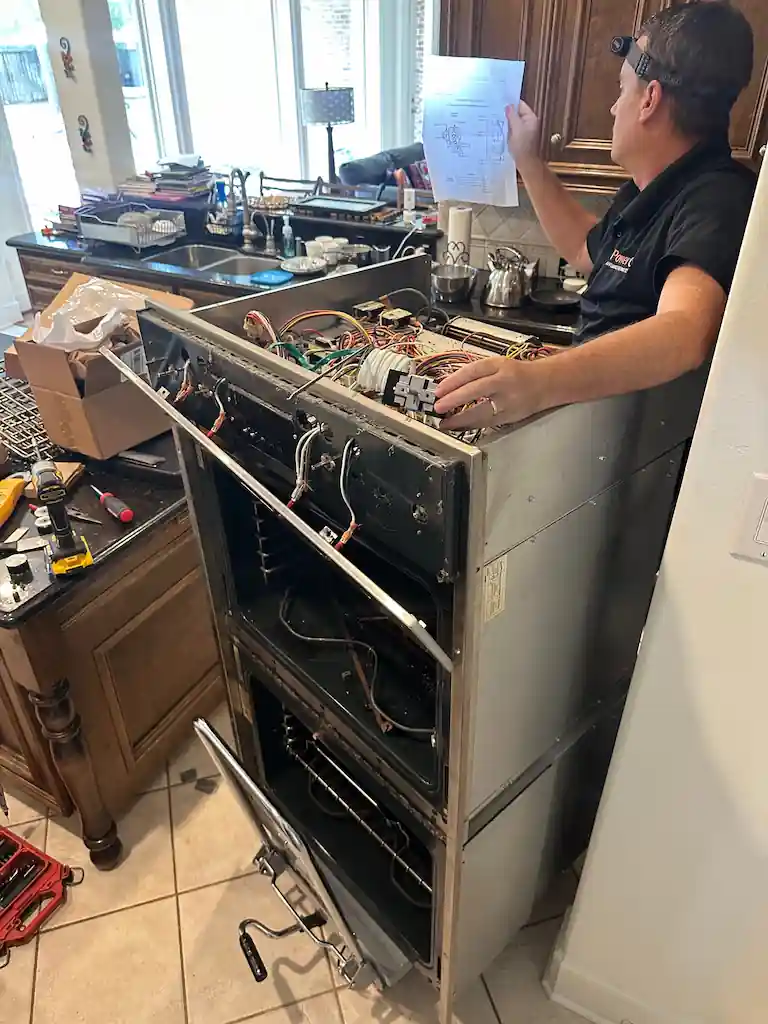
We got a call this week from a homeowner in The Woodlands, TX with a Viking built-in double oven that was giving them two separate headaches. The lower oven had turned into a gamble — sometimes it heated, sometimes it just sat there cold, no rhyme or reason to it. And the upper oven had a slower, sneakier problem: it just took forever to get to temperature, and honestly, it never quite got there.
Two ovens, two different failures, same brand, same day. This is a good one to walk through, because both problems come up constantly in Viking builds and premium ranges in general, and most homeowners have no idea what’s actually happening behind that stainless panel.
The Lower Oven: A Thermostat Playing Games
The lower oven’s symptom was the classic “flickering” heat — it would kick on, then cut out, then maybe come back, with no consistency a person could predict. That kind of intermittent, unpredictable heating almost always points to one thing: the thermostat itself is failing, not the heating element.
Here’s the distinction that matters. A dead heating element gives you a clean, obvious failure — no heat at all, every time. A failing thermostat gives you inconsistent heat, because the thermostat is the component telling the oven “we’re at temperature, shut off” or “we’ve dropped below temperature, turn back on.” When that signal starts misfiring, the oven either overheats, undershoots, or does exactly what this one was doing — flickering on and off with no logic to it.
We confirmed it, pulled the old thermostat, and replaced it. Heat came back immediately, steady and predictable.
One thing worth knowing if you own an older Viking unit: this model still used a traditional mechanical thermostat, the kind that reads temperature with a capillary bulb and switches contacts directly. Newer Viking ovens have moved away from that design entirely — they now rely on an electronic control board paired with a temperature sensor (thermistor) instead of a thermocouple-style thermostat. It’s a more precise system, but when it fails, the diagnosis and the parts involved are completely different. If you’ve got an older unit, a bad mechanical thermostat is genuinely one of the more common failure points we see.
The Upper Oven: The Preheat Problem Nobody Explains
The upper oven’s issue was more subtle, and it’s one we get asked about all the time: “why is my oven taking so long to preheat, or never getting to the temperature I set?”
Most people assume the whole oven is “broken.” In reality, a double oven — Viking or otherwise — doesn’t heat with just one element running the whole time. During preheat, the oven is cycling through three or four separate elements, turning them on and off in sequence to climb to temperature as fast as possible:
- The bake element (bottom of the cavity)
- The broil element (top of the cavity, sometimes split into inner and outer sections on higher-end units)
- The convection element, if the oven has true convection
- On some Viking models, an inner and outer broil element working as a pair
When everything’s working, these elements fire in a coordinated rhythm to hit the set temperature quickly and then hold it. But if even one of those elements fails — or if the relay on the control board that’s supposed to activate it stops responding — the oven doesn’t shut off and throw an error. It just quietly does the job with fewer elements than it’s supposed to. That means slower preheats, temperatures that never quite arrive, and inconsistent baking that homeowners often blame on the wrong thing (an oven thermometer, a recipe, “this oven just runs cold”).
In this case, we found the outer broil element and the bake element on the upper oven had both failed. That’s why preheat was dragging and the set temperature was never actually reached — the oven was trying to compensate with only a fraction of its heating capacity.
We replaced both elements, and the upper oven is back to hitting temperature the way a Viking should — fast and accurate.
The Takeaway for Homeowners
If your oven is:
- Taking noticeably longer to preheat than it used to
- Never quite reaching the temperature you set, even after extra time
- Heating inconsistently, cutting in and out without a clear pattern
…it’s rarely “the whole oven.” It’s almost always one specific component — a single element, a relay on the control board, or the thermostat/sensor assembly. The fix is usually straightforward once the actual failure point is identified, which is the part that takes real diagnostic experience, especially on premium brands like Viking where the wiring and relay layout isn’t the same as a standard consumer range.
We work for tomorrow, not for today — meaning we don’t just get your oven hot again for this week’s dinner. We diagnose the actual failed component so you’re not calling us back in three months for the same symptom with a different part.
If you’re in The Woodlands, Spring, Tomball, Conroe, or anywhere else across our Houston-area service area and your Viking, Wolf, Thermador, Miele, GE, or other built-in oven isn’t preheating right, isn’t holding temperature, or is cycling unpredictably, reach out to our Woodlands-area appliance repair team — we’d rather find the real cause than guess.
Frequently Asked Questions
Why does my oven take so long to preheat all of a sudden?
A slow preheat almost always means one of the oven’s heating elements — bake, broil, or convection — isn’t turning on when it should. The other working elements try to compensate, so the oven still heats, just much slower than normal.
My oven never reaches the temperature I set. Is that a thermostat problem or an element problem?
It can be either. If the oven eventually gets hot but takes a long time, suspect a failed heating element. If the heat is inconsistent — turning on and off unpredictably — the thermostat or temperature sensor is the more likely culprit.
What’s the difference between older ovens and newer ovens when it comes to temperature control?
Older ovens, including many older Viking models, use a mechanical thermostat with a capillary bulb sensor. Newer ovens use an electronic control board paired with a temperature sensor, which is more precise but requires a different diagnosis and different parts when it fails. A part can read as faulty even though it’s perfectly functional itself. This is why an accurate diagnosis matters before replacing parts.
Is it normal for one oven in a double oven unit to fail while the other works fine?
Very common. Upper and lower ovens in a double oven typically have separate heating elements, separate thermostats or sensors, and often separate control boards or relay sections, so one can fail completely independent of the other.