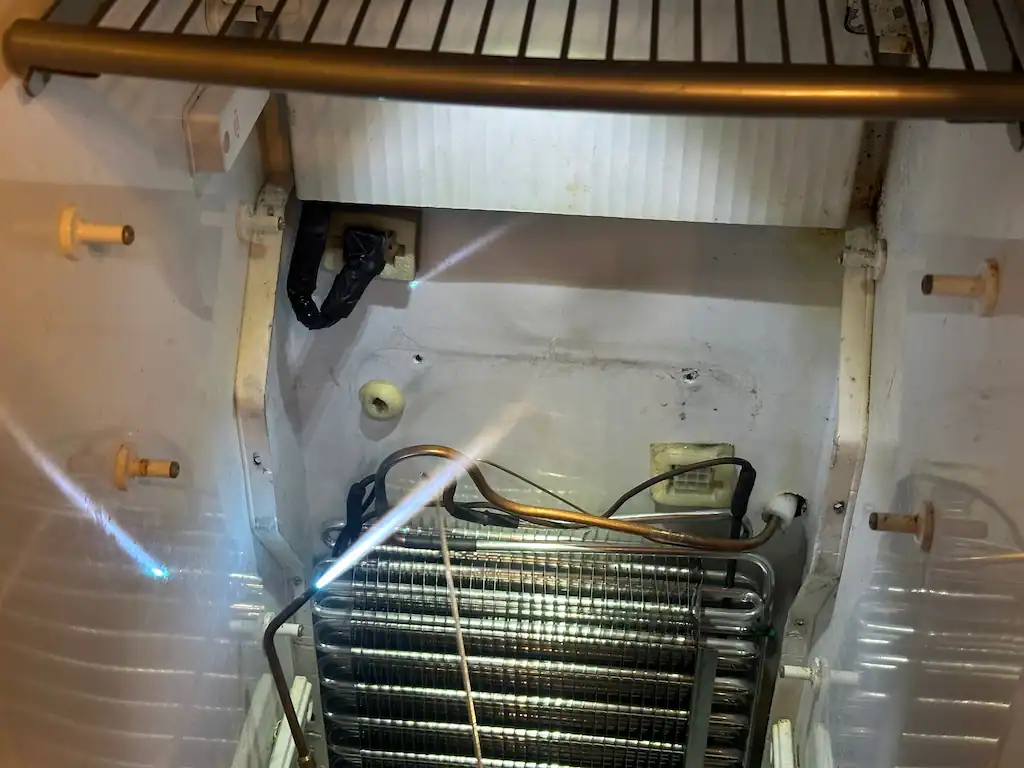
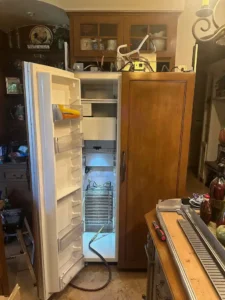
This Thermador refrigerator sealed system repair in Creekside Park started when a customer called us about a built-in Thermador refrigerator (built by KitchenAid) that had stopped cooling. No error codes, no obvious noise problem — the compressor was running, but the inside of the fridge was staying warm. That combination usually points to one place: the sealed system.
What We Found
This Thermador refrigerator sealed system repair in Creekside Park started with a clear diagnosis: the sealed system had a leak. All the refrigerant had escaped, so the compressor could run all day and never actually cool anything down. There was nothing left to compress. Before us, this customer got a quote from another company to replace just the evaporator. Their price for that one part was still higher than what we charge for a full sealed system rebuild.
Thermador Refrigerator Sealed System Repair Creekside Park: Why We Rebuilt the Whole System
When a sealed system leaks, the leak point usually isn’t the only issue. Moisture and old refrigerant oil circulate through the entire loop before we find the leak. That contamination doesn’t leave with the part you replace. Swap only the evaporator on a system that’s been leaking, and the compressor often fails a few months later. Sometimes the new evaporator starts leaking too. The rest of the system was never cleaned out.
We replaced the compressor, evaporator, heat exchanger, and dryer filter — the whole loop — using OEM parts throughout. That’s more work than a single-part swap, but it’s the difference between fixing the problem once and paying for it twice.
Sealed System 101: What These Parts Actually Do
Most homeowners never see inside a sealed system, so here’s what each part is doing back there.
Evaporator
This is the coil inside the freezer section, and it’s the coldest part of the whole appliance. Refrigerant arrives at the evaporator as a liquid, pushed through the narrow capillary tube, which drops its pressure right as it enters the coil. That pressure drop lets the liquid refrigerant boil off into a gas at a very low temperature. That phase change, liquid turning to gas, is what actually pulls heat out of the air around the coil. It’s the same idea as rubbing alcohol feeling cold as it evaporates off your skin. We just engineer it and seal it inside copper tubing. That’s the real mechanism that makes your fridge cold — not something blowing cold air in from outside, but refrigerant absorbing heat right there in the freezer as it changes state.
Condenser coils
Refrigerant leaves the compressor as a hot, high-pressure gas. It then runs through the condenser coils, where it gives off that heat and condenses back into a liquid before heading toward the capillary tube and evaporator. That released heat is why the air around or under a refrigerator often feels warm. On most residential units the condenser coils sit underneath or behind the unit. They’re the one part of the sealed system a homeowner can actually see and maintain. Everything else back there is sealed and off-limits.
Because they sit low, near the floor, condenser coils collect dust, lint, and pet hair fast. That buildup acts like insulation, and insulation is the last thing you want on a part whose whole job is releasing heat. A coated coil can’t reject heat efficiently. So the compressor runs longer and harder to hit the same temperature. That drives up your electric bill and shortens the compressor’s life. We recommend vacuuming or brushing off the condenser coils every six months, more often if you have pets.
Dryer filter
A small canister in the refrigerant line that catches moisture and debris. Refrigerant systems can’t tolerate moisture. It freezes inside the narrow capillary tube and blocks refrigerant flow. It can also react with the refrigerant and form acid that eats away at the compressor from the inside. Anytime we open a sealed system for a repair, we replace the dryer filter. Reusing an old one is one of the more common reasons a “fixed” sealed system fails again within the year.
Heat exchanger
The line that pairs the warm liquid refrigerant heading into the evaporator with the cold suction line heading back to the compressor. Running them alongside each other lets the warm line pre-cool before it even reaches the evaporator. It also warms the suction line enough to stop it from sweating and dripping condensation inside the unit. It’s a small part, but it affects both cooling efficiency and moisture control.
Drain pan heater
Sits underneath the unit, under the drain pan where the defrost water collects before it evaporates off. Without it, that pan can freeze over in a cold garage or a poorly insulated cabinet. Then defrost water backs up instead of draining. That’s one of the more common causes of a puddle under a built-in refrigerator that otherwise seems to be working fine.
Bonus Fix: Ice Maker Water Valve
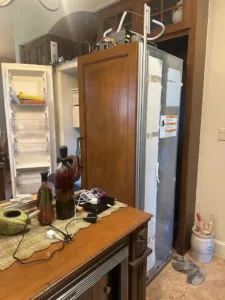
The unit was already out of the cabinet for the sealed system work, so we checked the ice maker. The customer had mentioned it was overfilling now and then. The water inlet valve wasn’t shutting off cleanly, so we replaced it. That was included in the same price. We were already in there, and it’s a five-minute job once you can reach the unit.
What This Thermador Refrigerator Sealed System Repair Means for You in Creekside Park
A Thermador refrigerator sealed system repair is one of the more expensive appliance repairs, and it’s also one where a quote for “just the one part” can be misleading. Say a shop only replaces the component that failed and doesn’t address the rest of the loop. Ask what happens if the same problem comes back in a few months. On a built-in unit like a Thermador, Sub-Zero, or Viking, pulling the unit out of the cabinet is most of the labor anyway. It’s worth doing the job right the first time you’re already in there.
Serving Spring and the Surrounding Area
We handle refrigerator, freezer, and full appliance repair across Spring, The Woodlands, Tomball, Cypress, Katy, Conroe, Magnolia, Montgomery, Willis, Huntsville, and Shenandoah. We work on everything from everyday Whirlpool and GE units to Sub-Zero, Wolf, and Thermador. If your built-in refrigerator has a sealed system leak, get the full picture before you pay for a partial fix.
Frequently Asked Questions
How do I know if my refrigerator has a sealed system restriction?
Common signs include the unit running constantly without reaching temperature, warm spots inside the fridge or freezer compartment, unusual noises from the compressor, or the compressor cycling on and off rapidly. A technician can confirm it by checking pressures and refrigerant flow.
Is a sealed system rebuild the same as a compressor replacement?
Not exactly. A compressor replacement swaps just that one part. A full sealed system rebuild replaces the compressor along with the evaporator, heat exchanger, and drier filter, so the entire refrigerant loop is clean rather than just the one component that failed.
Why not just replace the compressor and see if that fixes it?
If the restriction or contamination has already spread through the system, a new compressor connected to a still-contaminated loop will likely fail again, sometimes quickly. That’s wasted labor and cost on a fix that doesn’t hold.
Is a sealed system rebuild worth it on my refrigerator?
It depends on the brand and type of unit. On premium built-ins, almost always yes, since replacement costs are so much higher. On standalone refrigerators, we run the numbers with you first, because sometimes a new unit is the better financial call.
Do you work on older built-in models, or just current ones?
Both. Built-in units from these brands are common throughout North Houston homes, and age alone doesn’t rule out a repair — it just changes what the repair needs to include.
How long does a full sealed system rebuild take?
It’s a more involved repair than a standard part swap. It typically means careful evacuation, replacement of multiple components, and a full recharge and leak-check before the job is complete. Most rebuilds are completed in a single, longer visit.
If your built-in unit is showing the same warning signs, our refrigerator repair services across North Houston cover exactly this kind of work. You can also read more about how refrigerators work and how to keep them efficient from ENERGY STAR. When you need a Thermador refrigerator sealed system repair in Creekside Park done right the first time, we’re ready to help.