
One Water Softener Failure, Multiple Appliance Problems
Some service calls start with one appliance and quickly turn into something much bigger.
Today, our PowerOn Appliance Repair Service team worked at a home in Montgomery, Texas, where a failed water softener had released a large amount of tiny resin beads into the home’s plumbing system.
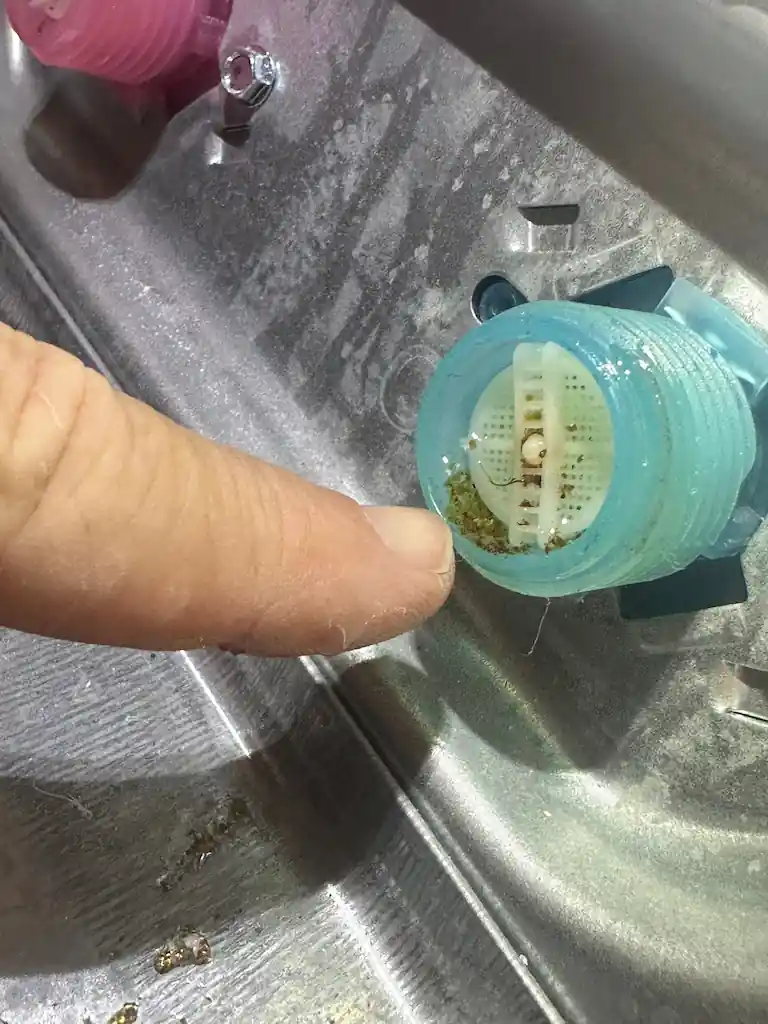
The first obvious problem was a leaking Maytag stackable washer. However, once we opened the washer’s water inlet system and found resin beads trapped inside, it became clear that this was not just a washing machine problem.
The same water supply feeds other appliances throughout the house, so we began checking the home’s other water-connected equipment as well.
By the time the job was complete, we had inspected, cleaned, flushed, or repaired two washing machines, a Maytag dishwasher, a Thermador dishwasher, a Thermador refrigerator, a Sub-Zero ice machine, and a Scotsman ice machine.
What Are Water Softener Resin Beads?
A traditional water softener contains thousands of very small resin beads inside its mineral tank. These beads are responsible for the ion-exchange process that removes hardness minerals such as calcium and magnesium from the home’s water.
Normally, the resin stays inside the water softener.
But when an internal component fails, resin beads can escape from the softener and enter the home’s plumbing. Because the beads are so small, they can travel surprisingly far through water lines and collect anywhere there is a screen, valve, filter, restriction, or small water passage.
That is where appliance problems begin.
Resin beads are supposed to remain inside the softener. Whirlpool Water Solutions also notes that resin beads escaping into household plumbing and appliances can indicate a problem with the water softener system.
The Maytag Stackable Washer Was Leaking
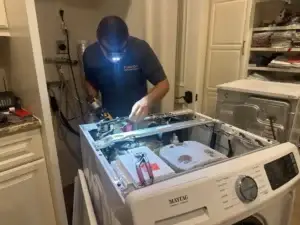
The Maytag washer was installed underneath a stacked dryer, so accessing the washer required more than simply removing a front panel.
We carefully disconnected the dryer, removed it from the washer, and placed it safely on the floor so we could properly access and diagnose the washing machine.
When we inspected the Maytag washer’s water inlet valve, we found resin beads trapped inside the valve.
The contamination had affected the valve’s ability to control incoming water correctly, and the valve was leaking.
Because the valve was no longer operating reliably, we replaced the Maytag washer water inlet valve. After installation, we reassembled the laundry system, ran the washer through its fill operation, and carefully checked the connections and valve area for leaks.
The washer was operating normally again.
We Checked Both Washing Machines in the Home
The home had two separate washing machine and dryer sets.
Once resin beads are found in one appliance, we do not assume the contamination stopped there. Both washing machines were connected to the same home’s water system, so the second washer also needed to be inspected.
Depending on the amount of contamination and the condition of the inlet valve, sometimes the screens and water passages can be cleaned and flushed. If the valve has been damaged or no longer closes correctly, replacement is the safer repair.
Maytag Dishwasher Water System Inspection
We also checked the home’s Maytag dishwasher.
Dishwashers use electrically controlled water inlet valves with relatively small openings. Those openings can easily collect debris that has traveled through the home’s plumbing.
We inspected and cleaned the affected water inlet area and flushed out the resin contamination before testing the dishwasher’s water fill operation.
Thermador Dishwasher Inspection and Cleaning
The home’s Thermador dishwasher was also connected to the contaminated water supply.
We inspected its water inlet system, removed the resin beads we could access, flushed the water path, and tested the appliance afterward.
This is an important step after a water softener failure because an appliance may appear to be working normally even though debris has already started accumulating inside the water inlet system.
Thermador Refrigerator Water Filter Housing Replacement
The contamination also reached the home’s Thermador refrigerator.
Modern refrigerators can have fairly complex water systems. Depending on the model, incoming water may pass through inlet valves, filter housings, water tanks, tubing, dispensers, and the ice-making system.
In this case, the Thermador refrigerator water filter housing assembly was affected and required replacement.
After installing the new housing assembly, we checked the water system and verified proper water flow.
Sub-Zero Ice Machine Cleaning and Flushing
The home’s Sub-Zero ice machine also needed attention.
Ice machines continuously bring fresh water into the appliance, which makes them especially important to inspect after plumbing contamination.
We cleaned and flushed the affected water areas of the Sub-Zero ice machine to remove resin beads and debris that had entered the system.
After cleaning, we checked the water supply and operation of the machine before returning it to service.
The Scotsman Ice Machine Required a Water Reservoir Assembly
The Scotsman ice machine was one of the more interesting parts of today’s repair.
On this particular machine, the incoming water level is controlled by a float-style inlet system that is part of the water reservoir assembly.
Because the float water inlet mechanism is integrated into the reservoir, we could not simply replace a traditional standalone solenoid inlet valve.
We removed the contaminated reservoir assembly and installed a new one.
We also thoroughly rinsed and flushed the inside of the ice machine to remove remaining resin beads from the water system.
Once everything was reassembled, we tested the water fill level and ice machine operation to make sure the new reservoir and float system were working correctly.
Why Tiny Resin Beads Can Cause Big Appliance Problems
Water softener resin beads may look harmless, but appliance water systems contain many small passages and precision components.
The beads can become trapped inside:
- Washing machine water inlet valves
- Dishwasher inlet valves
- Refrigerator filter housings
- Refrigerator water valves
- Ice machine reservoirs
- Ice maker fill systems
- Water dispenser lines
- Valve screens and filters
- Flow meters and small water passages
Once enough debris accumulates, the appliance may begin showing symptoms such as slow water flow, incomplete filling, no water entering the appliance, leaking valves, abnormal ice production, or continuous water flow.
Why a Leaking Water Inlet Valve Should Not Be Ignored
A partially clogged water valve does not always fail by completely stopping the water.
Sometimes the opposite happens.
Debris can prevent the valve from sealing correctly after it closes. Even a very small amount of water continuing through the valve can eventually create a leak.
That becomes especially important with washing machines and ice machines because they are often connected to a pressurized water supply around the clock.
A small valve problem can eventually become a much larger water-damage problem.
What Should You Do If Your Water Softener Releases Resin Beads?
If you suddenly notice tiny yellow, amber, orange, or brown beads coming from faucets, aerators, shower heads, appliance screens, or water lines, the water softener may have failed internally.
We recommend taking the problem seriously.
- Stop using or bypass the failed water softener. Continuing to run water through it may release additional resin into the plumbing.
- Have the plumbing system properly flushed. Resin may remain inside water lines even after the softener itself has been repaired.
- Clean faucet aerators and accessible screens. These are common places for resin beads to accumulate.
- Inspect water-connected appliances. Washing machines, dishwashers, refrigerators, and ice machines should all be considered.
- Watch carefully for leaks. Contaminated valves may not fail immediately.
- Replace damaged components when necessary. Cleaning may work when contamination is minor, but a valve or assembly that no longer operates reliably should be replaced.
Should Every Appliance Be Replaced After a Water Softener Failure?
No.
Finding resin beads in a home’s plumbing does not automatically mean every valve or appliance needs a new part.
That is why inspection matters.
Some components can be carefully cleaned and flushed if the resin has not damaged them. Others, such as the leaking Maytag washer inlet valve and the Scotsman reservoir assembly from today’s service call, may need replacement because contamination has affected their operation.
The correct repair depends on the appliance, the design of its water system, the amount of contamination, and whether the affected component still operates properly after cleaning.
A Good Example of Why Appliance Diagnosis Goes Beyond Replacing Parts
If we had treated today’s visit as only a leaking Maytag washer repair, we could have replaced the washer valve and left.
But the resin beads inside that valve told a much bigger story.
They showed us that debris had entered the home’s plumbing system and could potentially be inside every appliance connected to that water supply.
That is why we checked the other appliances.
The result was a combination of cleaning, flushing, inspection, and targeted part replacement rather than unnecessarily replacing components throughout the home.
For us, appliance repair is not about replacing the first bad part we see. It is about understanding why the part failed and determining whether the same cause could affect something else.
Appliance Repair in Montgomery, TX
If your water softener has failed and you are finding resin beads in your plumbing, do not forget about the appliances connected to that water supply.
PowerOn Appliance Repair Service repairs and services washing machines, dishwashers, refrigerators, freezers, ice machines, and other major appliances throughout Montgomery, Texas and surrounding communities.
If you have already noticed slow water flow, a leaking washer, dishwasher fill problems, refrigerator water issues, or unusual ice machine operation after a water softener failure, having the appliances inspected early may help prevent a more expensive problem later.
PowerOn Appliance Repair Service — we don’t work for today, we work for tomorrow.
Frequently Asked Questions
Can a failed water softener damage household appliances?
Yes. If a water softener releases resin beads into the plumbing system, those beads can travel into washing machines, dishwashers, refrigerators, ice machines, and other water-connected appliances. They can clog valves, screens, filter housings, reservoirs, and small water passages.
What do water softener resin beads look like?
Water softener resin usually appears as very small round beads that may look yellow, amber, orange, tan, or brown. Homeowners may first notice them inside faucet aerators, shower heads, appliance inlet screens, sinks, or water filters.
Can water softener resin beads make a washing machine leak?
Yes. Resin beads can become trapped inside a washing machine’s water inlet valve. If they interfere with the valve’s internal seal, the valve may not close completely and can begin leaking or allowing water to enter when it should be shut.
Should I inspect my refrigerator after a water softener failure?
Yes. Refrigerators often contain water inlet valves, filter housings, ice makers, dispensers, tubing, and other small water passages that can collect resin beads. An inspection is especially important if water flow becomes slow or the ice maker starts behaving differently.
Can resin beads damage a dishwasher water inlet valve?
They can. Dishwasher inlet valves have small openings and internal seals. Resin beads or other plumbing debris may restrict water flow or interfere with proper valve operation.
Can an ice machine be affected by water softener resin?
Yes. Ice machines repeatedly fill with fresh water, so resin beads can enter reservoirs, inlet valves, float assemblies, water lines, and other internal components. Depending on the design and severity of contamination, the system may need cleaning, flushing, or part replacement.
Do all contaminated appliance valves need to be replaced?
No. Some valves, screens, and water passages can be cleaned if contamination is minor and the component continues to operate correctly. If a valve leaks, sticks, has restricted flow, or cannot be reliably cleaned, replacement may be the better repair.
Why was the Scotsman ice machine reservoir replaced?
On the Scotsman model we serviced, the float-style water inlet mechanism was integrated into the water reservoir assembly. Because the contaminated inlet system was part of that assembly, the reservoir needed to be replaced as a complete component.
What appliances should be checked after a water softener releases resin beads?
At minimum, consider checking washing machines, dishwashers, refrigerators with water or ice systems, stand-alone ice machines, and other appliances directly connected to the home’s water supply.
Does PowerOn Appliance Repair Service repair appliances in Montgomery, Texas?
Yes. PowerOn Appliance Repair Service provides professional appliance repair in Montgomery, TX, including washer, dishwasher, refrigerator, freezer, ice machine, and premium appliance service.